Fiber for Industrial Floors: How to Choose and Place It
Reinforce Global ·
The main fiber for industrial floors is structural fiber: Class II macro synthetic fiber to EN 14889-2 or steel fiber to EN 14889-1. In slabs on grade, macro fiber replaces steel mesh when this is confirmed by calculation. The ReinStrong DoP dose, which provides fR1 ≥ 1.5 MPa and fR4 ≥ 1.0 MPa, is 4.5 kg/m³. The design dose for a specific slab is set by an engineer, who accounts for racking and forklift loads, slab thickness and the sub-base.
Micro fiber does a different job in an industrial floor: it reduces shrinkage cracks in fresh concrete, but it does not reinforce hardened concrete and does not replace steel mesh. In load-bearing structures (suspended slabs, beams, columns), fiber does not replace structural rebar without engineering calculations.
Below we cover which fiber to choose for a warehouse or factory floor, what the engineer needs for the design, how to place fiber concrete and where mistakes happen most often.
Why industrial floors crack and what fiber does
An industrial floor differs from an ordinary concrete slab mainly in the loads it carries:
- Racking presses on the slab through the small base plate of each upright, and this load acts for years.
- Forklifts apply moving, impact and repeated loads. Small hard wheels and joint edges are the toughest cases for the slab.
- Abrasion comes from wheels, pallets and carts.
- Shrinkage and temperature changes act on every slab, and outdoors there are also frost, de-icing salts and chemicals.
Fiber does not make concrete crack-proof. Micro fiber reduces plastic shrinkage cracking in the first hours, while the concrete is still fresh. Macro fiber starts working once a crack has formed: the fibers “stitch” it, limit how far it opens and continue to transfer load across it. Fiber does not raise the compressive strength class of concrete; the mix design sets it.
Macro fiber, micro fiber, steel fiber or steel mesh
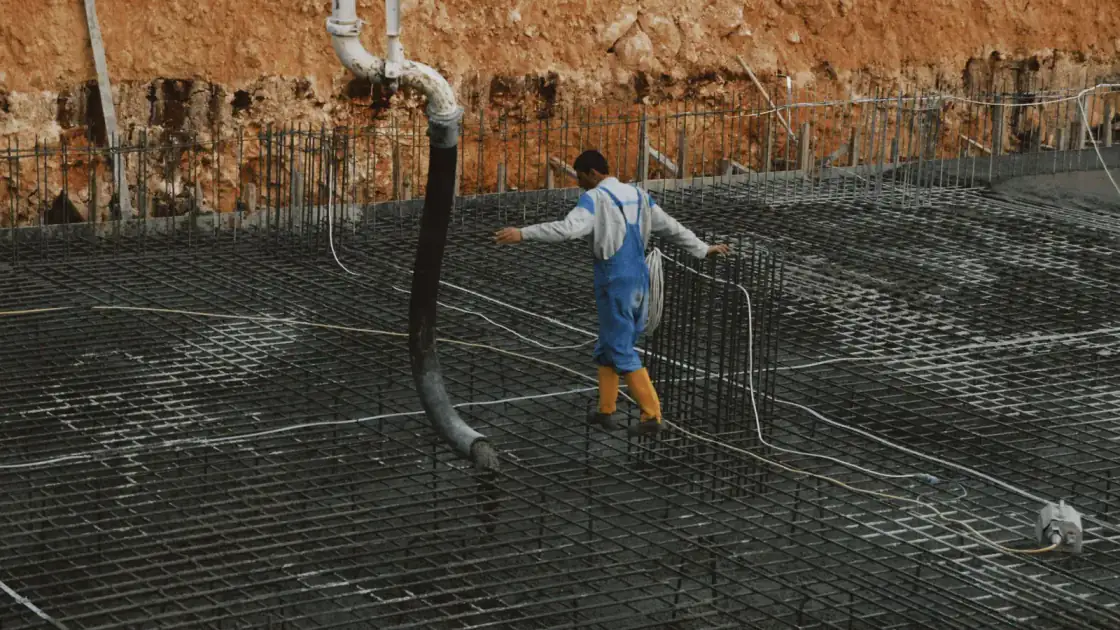
Steel mesh works in one plane, and unless it is well supported on chairs, workers walking on it during the pour often push it to the bottom of the slab. Macro fiber is distributed through the entire depth, from the bottom of the slab to the surface, and arrives on site already in the concrete. For a detailed comparison, see fiber vs steel mesh for concrete floors.
| Macro fiber (ReinStrong, ReinFlex) | Micro fiber (ReinLite) | Steel fiber | Steel mesh | |
|---|---|---|---|---|
| What it does | Holds cracks together in hardened concrete | Reduces shrinkage cracks in fresh concrete | Holds cracks together in hardened concrete | Reinforces in one plane |
| Dose for an industrial floor | ReinStrong 4–5 kg/m³, ReinFlex 3–5 kg/m³ | 0.6–0.9 kg/m³ (concrete, slabs; shrinkage only) | Typically 20–40 kg/m³ | Per the reinforcement design |
| Replaces steel mesh | Yes, if confirmed by calculation | No | Yes, if confirmed by calculation | — |
| Corrosion | None | None | Surface fibers only: possible rust spots | Possible, especially near the surface |
| Wear on pumps and drums | Low | Very low | High | — |
| Work on site | None: the fiber arrives in the concrete | None | None | Tying, chairs, crane |
Macro fiber for industrial floors is lighter and safer to handle than steel fiber: the dose for 1 m³ weighs several times less, and the fibers do not cut hands or rust. The absence of corrosion matters most for outdoor yards, parking lots and buildings exposed to salts and chemicals.
Steel fiber has its own strengths. Its modulus of elasticity is about 200 GPa, compared with 11 GPa for ReinStrong. Under sustained load, cracked concrete with polypropylene fiber deforms (creeps) more than concrete with steel fiber, so under heavy permanent racking loads the dose and slab thickness must be confirmed by calculation with an adequate margin. Among fiber-reinforced floors, large jointless ones are typically built with steel fiber. All five of our fibers and steel fiber are compared in the fiber comparison table.
How a fiber-reinforced industrial floor is designed
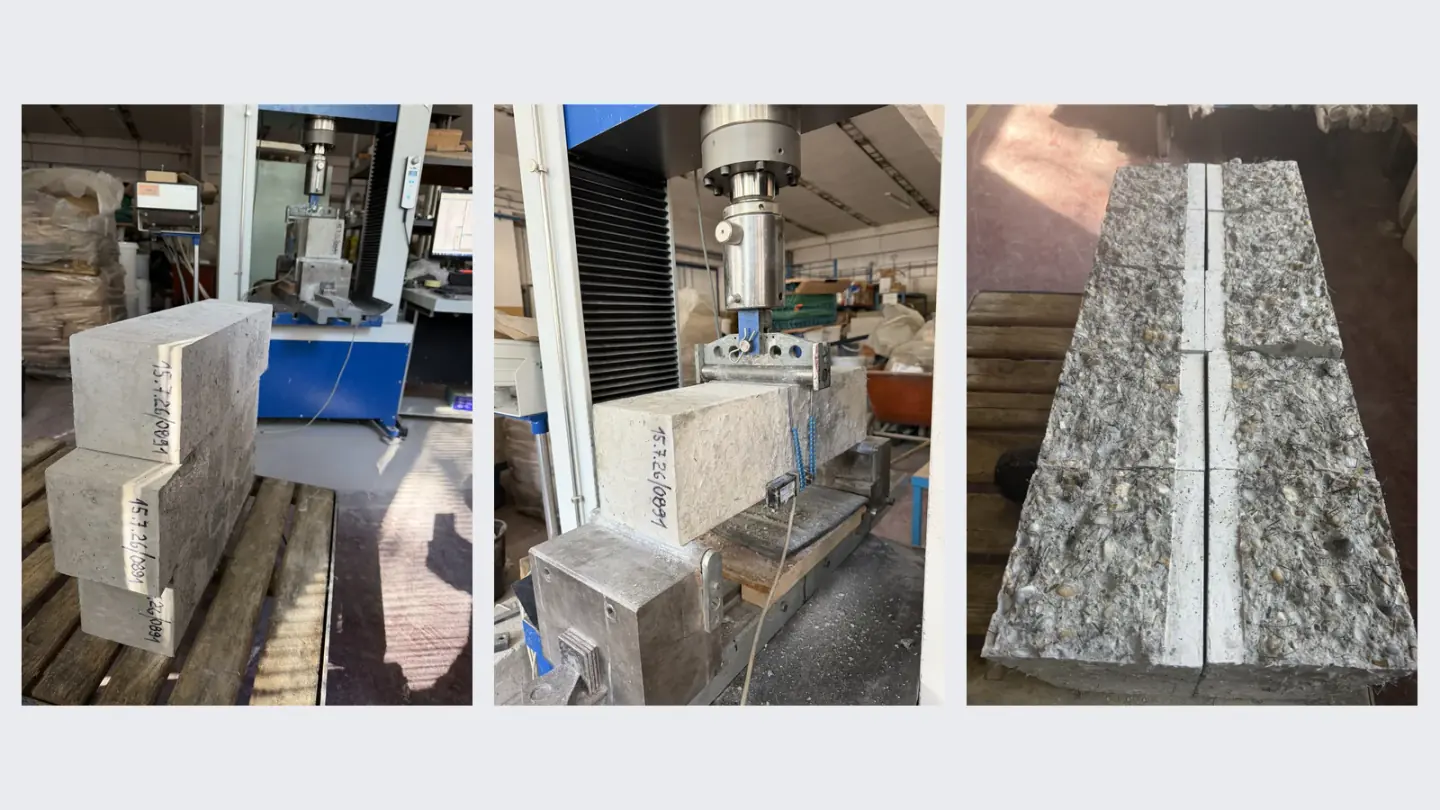
Macro fiber performance is measured to EN 14651: a notched concrete beam is broken in a press, and its residual flexural tensile strength is recorded. fR1 is the residual strength at a crack mouth opening displacement (CMOD) of 0.5 mm, and fR4 is the value at 3.5 mm. The engineer uses the characteristic values of fR1 and fR4, obtained from a series of beams for the given fiber and dose, in the slab design. We show how the test works in our article on the CMOD test to EN 14651. In summer 2026, ReinStrong and ReinFlex were tested to EN 14651 at TSÚS in Bratislava.
In European practice, fiber-reinforced slabs on grade are often designed to the UK guide TR34 (Concrete Society, 4th edition). It converts fR1 and fR4 into design stresses and checks the slab for bending and punching shear under a racking upright and a forklift wheel. For macro synthetic fiber, TR34 assumes no increase in punching shear capacity, so under heavy uprights punching often governs slab thickness. TR34 also says that the long-term creep of macro synthetic fiber needs to be considered. Moving forklift loads take a higher partial safety factor than static racking loads: 1.6 versus 1.2 in TR34. The minimum slab-on-grade thickness TR34 recommends is 150 mm.
Two things a client should know:
- The DoP dose is not the dose for your floor. It shows how much fiber gives fR1 ≥ 1.5 MPa and fR4 ≥ 1.0 MPa in a reference concrete. For a slab under specific racking, the design may call for a different dose.
- The same dose by weight does not give the same result. Different fibers at the same dose reach different residual strengths, so products are compared on EN 14651 results, not on weight.
To let the engineer design the slab, prepare:
- Racking: load per upright, base plate size, spacing between uprights.
- Equipment: forklift type, wheel load, wheel type, traffic intensity.
- Sub-base: subgrade soil, granular sub-base, degree of compaction.
- Concrete and slab: concrete class, planned thickness, and whether it is an indoor floor or an outdoor yard.
- Fiber documents: the Declaration of Performance (DoP), the technical data sheet (TDS) and EN 14651 test results.
We send the technical data sheet (TDS) and quality certificate for our fiber on request, and we will confirm in our reply which EN 14651 data we can provide for your project. We also help with dosage calculation, trial mixes and project support.
How much fiber a warehouse floor needs
Our product pages give these indicative doses:
| Fiber | Application | Dose |
|---|---|---|
| ReinStrong | Industrial floors, outdoor paved areas | 4–5 kg/m³ |
| ReinFlex | Industrial floors, roads | 3–5 kg/m³ |
| ReinBasalt | Industrial floors, abrasion resistance | 1.5–2.5 kg/m³ |
| ReinLite | Concrete, slabs: against shrinkage cracks | 0.6–0.9 kg/m³ |
Only ReinStrong and ReinFlex do structural work in this table. ReinBasalt and ReinLite are micro fibers and do not replace steel mesh. Lower macro fiber doses, such as ReinStrong at 2–3 kg/m³, suit lightly loaded slabs on grade and control shrinkage cracks. They are below the DoP dose, so without EN 14651 tests they are not used in a design for racking and forklift loads.
In international practice, macro synthetic fiber doses in industrial floors typically fall within 2–6 kg/m³, and the final figure comes from the design. The quantity for a project is calculated as concrete volume × dose. For example, a 1,200 m² warehouse slab that is 200 mm thick takes 240 m³ of concrete. If the design confirms 4.5 kg/m³, you need 1,080 kg of ReinStrong. This is based on the theoretical volume: fiber is dosed on the concrete actually delivered, so add the same allowance for sub-base tolerance and waste that you order for the concrete. Doses for other applications are collected in concrete fiber dosage per m³.
How to place an industrial floor with fiber
- Sub-base. An industrial floor with fiber still needs a level, well-compacted sub-base. Where high spots in the sub-base leave the slab thinner than designed, it loses its safety margin.
- Adding the fiber. Fiber concrete for a warehouse floor is easiest to produce at the batching plant: add the fiber together with the aggregates or with the first portion of water. In a truck mixer, add it at the start of loading. If you add fiber to ready-mixed concrete, mix at maximum drum speed for another 5 min (at least 70 drum revolutions). ReinFlex added during or after batching is mixed for 4–5 min at operating drum speed.
- Workability. Macro fiber slightly reduces slump. Compensate with a superplasticizer (PCE), not with water, and agree its dose with the concrete supplier; slump at discharge should be S3 or higher. Make a trial batch before your first project. Why the slump test can mislead with fiber concrete is explained in our article on the Vebe test.
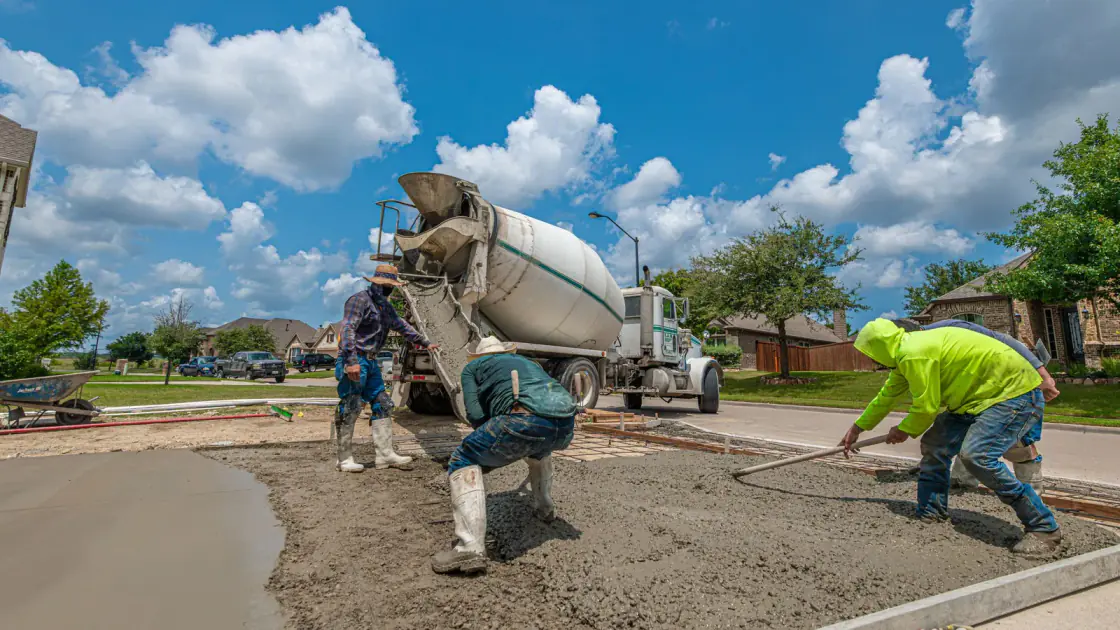
- Placing. Concrete with macro fiber can be pumped. For ReinFlex, fit the pump hopper with a grate made of round bars and a vibrator. With no steel mesh in the way, the truck mixer can often discharge straight onto the sub-base, provided the truck does not rut it: a rutted sub-base no longer gives the design slab thickness.
- Screeding. Use a vibrating screed or a laser screed. Vibration consolidates the concrete and embeds the fibers below the surface. Do not over-vibrate: excess paste at the top gives a weak surface that dusts and crazes.
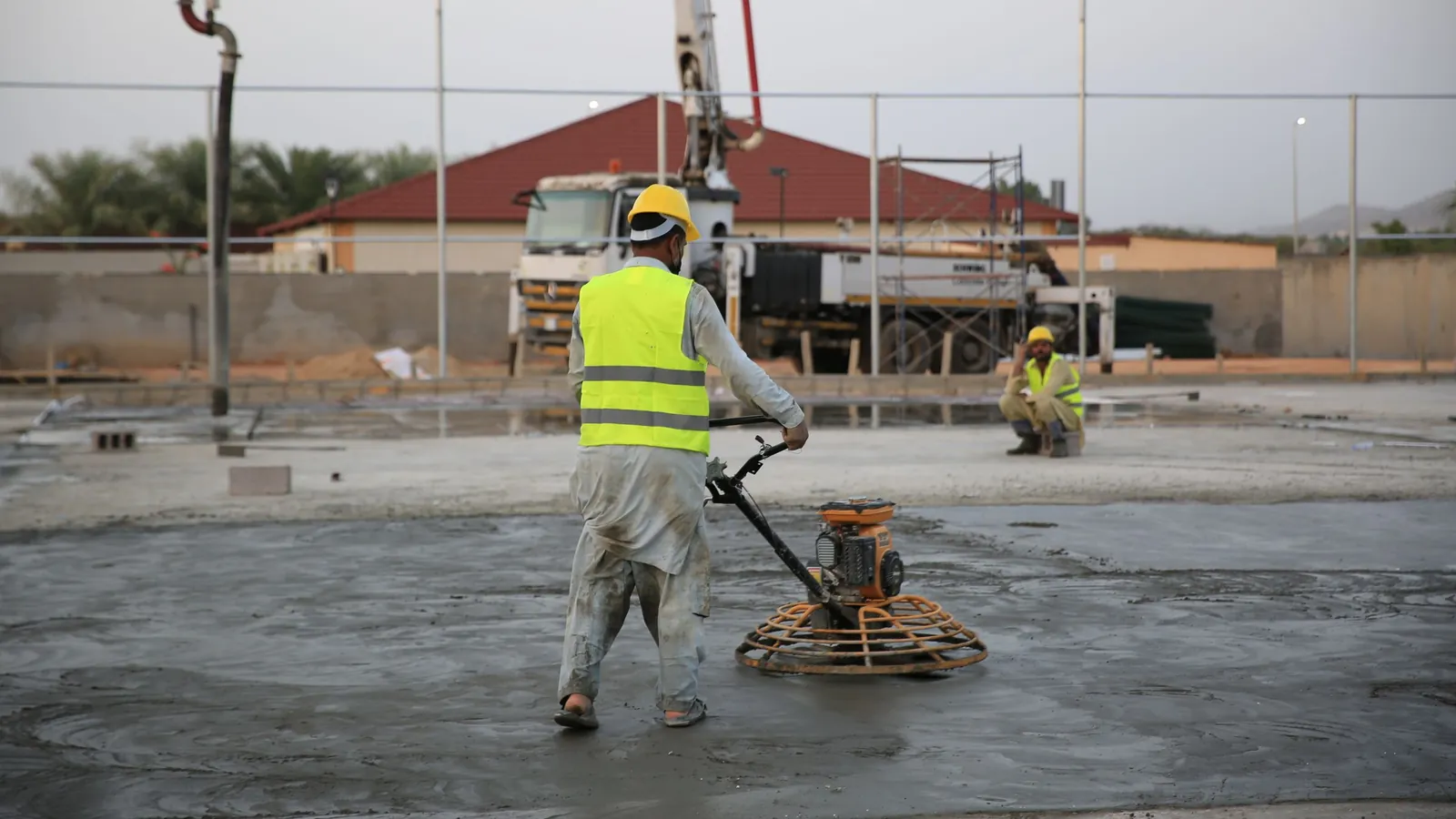
- Start of troweling. Start when the bleed water has gone from the surface; a common rule of thumb is a footprint no deeper than 3 mm. Fiber reduces bleeding, so the surface can look dry before the concrete is ready to trowel. Go by the footprint test, not by how the surface looks. Make the first pass with float pans on the power trowel.
- Dry-shake hardener (if specified). A dry-shake hardener (quartz or corundum) is typically spread in two passes after the first float pass and worked in with the power trowel before final blade troweling. Do not spread it on bleed water or close the surface too early: this is a common cause of delamination. The hardener also hides fibers near the surface. The application method is set by the hardener manufacturer.
- Final troweling. Then switch to blades, kept flat and at low speed. For hand floats, use magnesium, not wood. If fibers come up to the surface, the concrete is still too green for blades: pause and continue once the surface has stiffened further.
- Curing. Right after troweling, cover the concrete with plastic sheeting, keep it moist or apply a curing compound. Fiber does not replace curing.
Fibers that still come to the surface are cut off or burned off after the concrete hardens, but the flame must not overheat the concrete. If the floor will be ground, polypropylene macro fiber near the surface will show as visible cut fiber ends. For ground and polished floors and toppings, ReinBasalt can be added: its fibers do not pull out or make the surface fuzzy when the floor is ground. It is a micro fiber, however, and provides no structural reinforcement: if a loaded slab needs reinforcement, the design provides it with steel mesh or structural fiber, not with ReinBasalt.
Joints in fiber-reinforced floors
Fiber does not eliminate joints, neither saw-cut contraction joints nor isolation joints. It holds together cracks that have already formed, but it does not stop the slab from shrinking.
- Panel size. Saw-cut floors with macro synthetic fiber are typically divided into panels with joints about 4–6 m apart, and thinner slabs need closer joints. Keep the panel aspect ratio at no more than 1 : 1.5, ideally square. The exact joint layout is set by the design.
- When to cut. As early as possible, as soon as the cut edge stops raveling. Early-entry saws are typically used 1–4 h after finishing, and conventional saws typically 4–12 h after finishing, sooner in hot weather. Do not leave sawing until the next day: 24 hours is the outer limit, not the target. A crack that forms before the cut makes the joint useless.
- Depth. With a conventional saw, typically 1/4–1/3 of the slab thickness, and closer to 1/3 for fiber concrete: the fibers hold the concrete together under the cut, and with a shallow cut the crack may form away from the joint. Early-entry saws make a shallower cut, so their use and the cut depth on fiber concrete should be agreed with the designer. The final depth is set by the design.
- Isolation and construction joints. Columns, walls, pits and machine bases are separated from the slab with isolation joints, and re-entrant corners get extra joints or local reinforcement per the design. Construction joints between pours that carry forklift traffic are built with dowels or steel edge protection (armored joints), as the design specifies.
Large jointless panels are typically built with steel fiber on a slip membrane (usually 1,000–2,500 m²), with post-tensioning or with shrinkage-compensating concrete. Such a floor needs its own design and its own concrete mix.
Common mistakes
- Water instead of superplasticizer. Extra water lowers strength and increases shrinkage, segregation and the number of fibers at the surface.
- Micro fiber instead of macro fiber. Fine, short fibers reduce shrinkage cracks but do not replace steel mesh in a loaded slab.
- A table dose instead of a design. Or a dose lower than required: then fiber concrete behaves almost like plain concrete.
- Fiber dumped in a heap or mixed too briefly. The fibers ball up and spread unevenly.
- Troweling too early. The blades pull the fibers up. Wooden floats and burlap drags do the same.
- Joints cut too late or too shallow. The slab cracks where it wants to, not along the joints.
- No curing. The surface dries out and cracks, whatever fiber is in the concrete.
- Expecting fiber to raise the concrete class or, on its own, allow a thinner slab. Thickness is set by the loads, the sub-base and the design.
Choosing Reinforce fiber for industrial floors
- ReinStrong, the classic macro fiber for most slabs on grade: jointed industrial and warehouse floors, outdoor yards and surface parking lots, when the dose and slab thickness are confirmed by the design. It is a stiff polypropylene monofilament, 40 mm long, with a ribbed, wavy surface, Class II to EN 14889-2.
- ReinFlex, when you need maximum toughness and impact resistance: floors with heavy forklift traffic and racking in warehouses, logistics centers and auto service shops. The 38 mm twisted bundle opens up during mixing, so one product both protects against shrinkage cracks and reinforces hardened concrete. It replaces micro fiber and steel mesh when this is confirmed by calculation. Under heavy racking, as with any polypropylene fiber, the dose and slab thickness are confirmed by a design that accounts for creep. Its gray color masks fibers at the surface.
- ReinBasalt, for floors where abrasion resistance matters, and for ground and polished floors and toppings. It is a micro fiber: it does not replace steel mesh or macro fiber.
- ReinLite, only against shrinkage cracks in fresh concrete, for example in a slab where steel mesh stays in the design.
Screeds and heated floors are a separate topic: see polypropylene fiber for screed.
We make ReinStrong, ReinFlex, ReinBasalt and ReinLite at our own production facility, export to 15 EU countries and are looking for distributor partners. Get a quote: tell us about your market or project, and we will help you choose fiber for industrial floors, assist with dosage questions and trial batches, and arrange orders and delivery to your country. How the partnership works is explained on our distributors page.
In short: questions and answers
Which fiber does an industrial floor need?
Structural fiber: Class II macro synthetic fiber to EN 14889-2, such as ReinStrong or ReinFlex, or steel fiber to EN 14889-1. It holds cracks together in hardened concrete and, in slabs on grade, replaces steel mesh when this is confirmed by calculation. Micro fiber only reduces shrinkage cracks in fresh concrete and does not replace steel mesh.
How much fiber per m³ does a warehouse floor need?
Indicative doses for industrial floors are ReinStrong 4–5 kg/m³ and ReinFlex 3–5 kg/m³. The ReinStrong DoP dose, which provides fR1 ≥ 1.5 MPa and fR4 ≥ 1.0 MPa, is 4.5 kg/m³. The design dose for a specific slab is set by an engineer for the loads, slab thickness and sub-base.
Which is better for an industrial floor: steel fiber or macro synthetic fiber?
Macro synthetic fiber does not rust, causes less wear on pumps and drums, and its dose weighs several times less than steel fiber (steel is typically dosed at 20–40 kg/m³). Steel fiber is typically chosen for large jointless floors. Which fiber your slab needs, and at what dose, is shown by the design calculation.
Can you add water if fiber concrete gets too stiff?
No. Extra water lowers strength and increases shrinkage. Restore workability with a superplasticizer (PCE), dosed as agreed with the concrete supplier; slump at discharge should be S3 or higher.
Will fibers stick out of the surface after power troweling?
With proper troweling, the fibers are barely visible. Do not start troweling too early: wait until the bleed water has gone from the surface; a common rule of thumb is a footprint no deeper than 3 mm. Use magnesium floats and keep the blades flat. The gray color of ReinFlex also helps mask fibers at the surface.
Can fiber make an industrial floor jointless?
Not with macro synthetic fiber at standard doses. Such a floor is still divided into panels by saw-cut joints, typically spaced about 4–6 m apart depending on slab thickness. Large jointless panels are typically built with steel fiber on a slip membrane, with post-tensioning or with shrinkage-compensating concrete, and they need a dedicated design.